Market InstituteMarket Institute
  • About
    • Who We Are
  • Research & Commentary
    • Papers
  • Events
  • Issues
  • Projects
    • International Overreach: When Global Standards Become U.S. Policy
    • Alzheimer’s
    • Letters
    • Political Cartoons

Social Media

Articles

Democrats’ Project 2029 Will Increase Government Control of the Internet

Market Institute Senior Fellow Norm Singleton is sounding the alarm over “Kids Over Clicks,” the first major policy proposal from Project 2029, a Democratic effort to develop a governing agenda for the next Democratic president. In a new piece for RealClearMarkets, Singleton argues that while the proposal is being sold Read more…

By admin, 1 month1 month ago
Articles

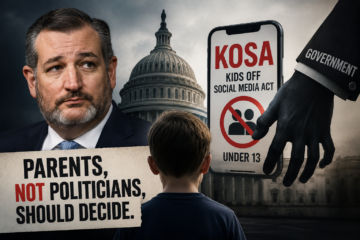
Ted Cruz and Brian Schatz Want To Be Our Nannies

Senator Ted Cruz built his political brand as a constitutional conservative who trusted parents and local communities more than Washington bureaucrats. But his support for the Kids Off Social Media Act (KOSA) marks a sharp departure from those principles. In a new piece, Market Institute Senior Fellow Norm Singleton argues Read more…

By admin, 4 months4 months ago
Articles

Parents and Tech Companies – Not Government – Must Protect Children

An op-ed by Market Institute President Charles Sauer in RealClearMarkets examines the growing push for government regulation of children’s social media use and argues that parents—not Washington—are best positioned to decide how and when their children engage online. Sauer discusses recent litigation involving Meta Platforms and Alphabet Inc., as well Read more…

By admin, 4 months4 months ago
Articles

Warning Labels Coming To a Social Media Site Near You

Minnesota is following in New York’s footsteps with a new law that requires mental health warning labels on social media platforms. Before accessing their favorite apps, Minnesotans will soon be forced to “acknowledge the potential for harm and choose to proceed to the social media platform despite the risk.” As Read more…

By admin, 1 year1 year ago
Papers

The Practical, Constitutional, and Moral Case Against Social Media Regulation “For the Children”

As the Federal Trade Commission holds workshops on how Big Tech is supposedly “harming kids,” policymakers from both the left and the right are uniting behind a dangerous idea: that government should regulate social media in the name of protecting children. But as this new paper makes clear, the real Read more…

By admin, 1 year1 year ago
Articles

Don’t Let the Sun Go Down On Section 230, Expand It Instead

In the vast landscape of internet regulation, few laws have been as influential—or as controversial—as Section 230 of the Communications Decency Act of 1996. At the heart of this debate are 26 words that have shaped the digital age: “No provider or user of an interactive computer service shall be Read more…

By admin, 2 years2 years ago
Articles

Searching for Scapegoats For His Own Failings, Eric Adams Happens On ‘Social Media”

In a recent State of the City address, Mayor Eric Adams of New York City ignited controversy by labeling social media as a “public health crisis” for children. Market Institute President Charles Sauer, a staunch advocate for free markets and individual liberty, challenges this narrative in his latest article in Read more…

By admin, 2 years2 years ago
Recent Articles
  • Trump’s FTC Places a Bull’s Eye On Affordability September 11, 2026
  • Will State Attorneys General Kill Off Hollywood? September 7, 2026
  • The Solution to Alleged AI Bias Will Be Found In the Market September 2, 2026
  • JD Vance’s Policies Run Counter to His Middle Class Embrace August 19, 2026
  • Mass. Must get Ahead of Health Care Fraud August 18, 2026
Recent Papers
  • The Trouble with Tariffs
  • The $135 Billion Lie: How Upcoding Is Draining Medicare and Medicaid
  • Why Does the Government Pay More for the Same Care?
  • The Practical, Constitutional, and Moral Case Against Social Media Regulation “For the Children”
  • Free Markets Under Attack from the Left and Right

Loading

By adding your phone number, you opt in to receive text messages

Facebook
Twitter
YouTube

The Market Institute Verified account Follow

The Market Institute promotes the work of free market think tanks and associations. We Get Government Out of the Way.

MarketInstitute
marketinstitute

The Market Institute

Verified account @marketinstitute ·
6h

Rural America has spent decades asking where the investment went.

Now billions in private capital, jobs, infrastructure and tax revenue show up — and suddenly economic development is a threat?

Rural America deserves a piece of the digital economy, too.

Bloomberg @business

Economic growth is hard to come by in many rural areas, but the promise of substantial tax income isn't always enough to outweigh other concerns over data centers https://www.bloomberg.com/news/features/2026-09-14/poor-towns-reject-data-centers-that-could-help-their-finances?taid=6aa7fdea6a20e5000103488c&utm_campaign=trueanthem&utm_content=business&utm_medium=social&utm_source=twitter

Reply on Twitter 2099518598389571758 Retweet on Twitter 2099518598389571758 Like on Twitter 2099518598389571758 X 2099518598389571758
marketinstitute

The Market Institute

Verified account @marketinstitute ·
11 Sep

Exactly, @sallypipes. A new invention earns a new patent. It doesn't reset the clock on an old one.

Calling innovation “abuse” makes for a convenient political talking point. It’s a lousy foundation for policy.

Sally Pipes @sallypipes

Adding a new patent doesn't extend the life of an old one. When a patent expires, it expires.

And @USPTO found no link between the number of patents on a drug and when generics enter the market.

New patents protect new inventions — not the original medicine all over again.

Reply on Twitter 2098471467411284001 Retweet on Twitter 2098471467411284001 1 Like on Twitter 2098471467411284001 1 X 2098471467411284001
marketinstitute

The Market Institute

Verified account @marketinstitute ·
11 Sep

The FTC says it cares about affordability.

So why is it attacking an Amazon ad system that delivers better results for advertisers without higher real costs?

@CharlesSauer explains how the FTC’s lawsuit could make advertising less efficient—and ultimately push prices higher.

Reply on Twitter 2098412774762135930 Retweet on Twitter 2098412774762135930 Like on Twitter 2098412774762135930 X 2098412774762135930

  • About
  • Research & Commentary
  • Events
  • Issues
  • Projects